
Assessment
Assessment at The Horsell Village School and Supporting Learning at Home
What is Assessment?
At our school, assessment is an ongoing part of teaching and learning. It helps us understand what children know, can do and need to learn next. We use assessment to celebrate achievements, identify any areas where additional support may be needed and ensure that every child makes good progress.
Most assessment takes place as part of daily classroom activities. Teachers carefully observe children, review their work, listen to their ideas and ask questions to check understanding. This information is used to plan lessons that build on children's strengths and address any gaps in learning.
We assess children across all areas of the curriculum, including reading, writing, mathematics and the wider curriculum. In Reception, assessment is based on the Early Years Foundation Stage (EYFS) framework and is closely linked to children's play, exploration and development.
Throughout the year, teachers monitor progress and share information with parents through consultation meetings and written reports. We believe that assessment should support confidence, encourage a love of learning and help every child achieve their full potential.
At the end of Year 1, children take part in the statutory Phonics Screening Check, and at the end of Reception, teachers complete the EYFS Profile. These assessments help us understand children's progress and ensure they receive the support they need to succeed.
Reception Baseline Assessment (RBA)
The Reception Baseline Assessment (RBA) is a short, statutory assessment that takes place within the first six weeks of children starting Reception. It is designed to provide a snapshot of each child's starting point when they begin school and assesses early communication, language, literacy and mathematics skills.
The assessment is carried out by a familiar member of school staff on a one-to-one basis using an interactive and practical format that is age-appropriate and engaging for young children. There is no preparation or revision needed, and children generally view it as a series of simple activities rather than a test.
The results are not shared as a score with parents and are not used to label or compare children. Instead, they provide a starting point that will be used nationally to measure the progress children make throughout their primary education. The assessment does not replace the ongoing observations and assessments that teachers carry out every day to understand and support each child's individual development and learning. To find out more, click on the following link:
Year 1 Phonics Screening Check
The Phonics Screening Check is a statutory assessment that takes place each year for children in Year 1. It is designed to assess how well children can use their phonics knowledge to read words by sounding them out and blending sounds together.
The check is carried out individually with a familiar member of staff in a calm and supportive environment. Children are asked to read 40 words, including a mixture of real words and 'alien' (nonsense) words. The alien words help to demonstrate that children can apply their phonics knowledge rather than relying on memory or picture clues.
There is no need for children to revise or prepare for the check. Daily phonics teaching throughout Reception and Year 1 provides the knowledge and skills they need. The assessment helps teachers identify children who may benefit from additional support with reading and allows us to ensure that every child continues to develop as a confident and successful reader.
Parents are informed of their child's result at the end of the school year. Children who do not meet the expected standard in Year 1 will receive further support and will have the opportunity to retake the check in Year 2. To find out more, click on the following link: Phonics Screening Check Information
Teacher Assessment
Assessment is at the heart of effective teaching and learning. At The Horsell Village School, teachers gather information about pupils' learning in a variety of ways to build a clear picture of attainment, development and wellbeing. This helps staff to identify successes, recognise any barriers to learning and plan teaching that meets the needs of all children.
Assessment is not limited to tests or formal tasks. It takes place every day through classroom interactions, observations, discussions, work produced by pupils and professional conversations between staff. By continually reviewing information about learning, teachers can adapt their teaching, provide additional challenge where needed and identify pupils who may benefit from targeted support.
Teachers will attempt to deepen their understanding of the children by:
· Observing pupils during lessons and wider school activities.
· Listening to pupils' responses, explanations and discussions.
· Reviewing learning in books and other completed work.
· Reflecting on the effectiveness of teaching and learning experiences.
· Sharing professional observations and judgements with colleagues.
· Working in partnership with parents and carers.
· Using assessment information to identify strengths and areas for development.
· Consulting with subject leaders and the Inclusion Team.
· Seeking advice from external specialists when appropriate.
· Participating in regular Pupil Progress Meetings with the Senior Leadership Team.
· Reviewing attainment patterns to inform future provision and support.
For pupils with SEND, a variety of assessments helps inform the needs of the child to enable them to access the curriculum. These assessment methods might include, but are not limited to:
· Additional time to complete activities or assessments where appropriate.
· Access arrangements for statutory assessments.
· Pre-teaching and post-teaching interventions.
· Monitoring the impact of targeted support programmes.
· Adapted learning activities and differentiated resources.
· Guided teaching groups and small-group provision.
· Advice and recommendations from external agencies.
· Individual Support Plan outcomes and reviews.
· Education, Health and Care Plan (EHCP) annual reviews.
· Behavioural, social and emotional monitoring tools.
· School-based diagnostic assessments.
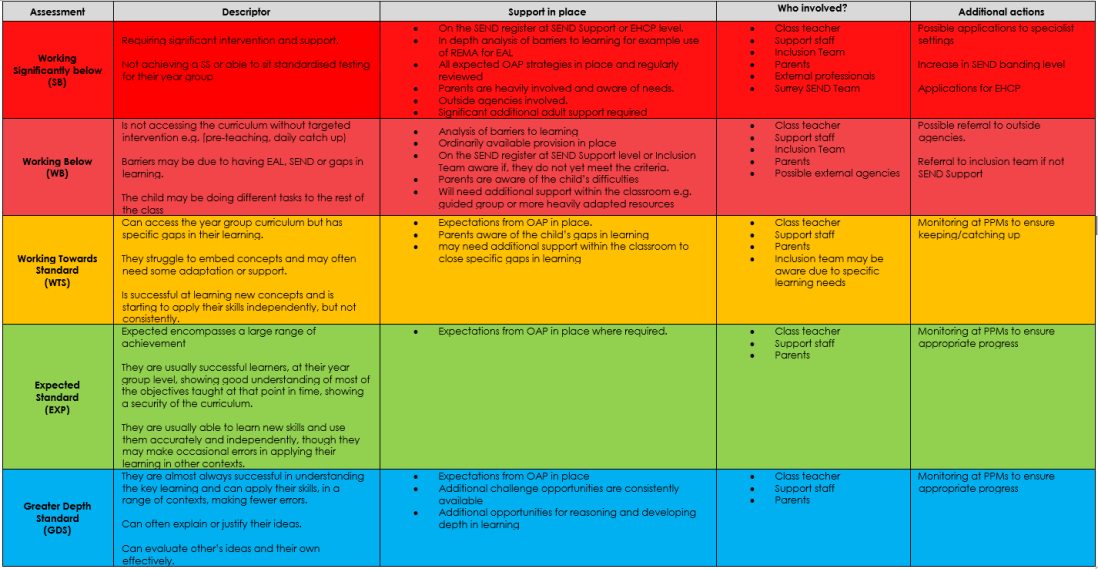
Pupil Attainment, Support and Intervention Framework
The framework below outlines how attainment is identified and the range of provision available to pupils at different stages of learning. It provides a consistent approach for staff when considering academic progress, wider developmental needs and appropriate next steps.
Using a shared set of expectations helps teachers make informed decisions about classroom support, intervention programmes and referrals for additional advice where needed. This ensures that pupils receive timely assistance, appropriate challenge and opportunities to develop confidence and independence throughout their learning journey.
Understanding Attainment and Progress
Attainment refers to what a child knows, understands and can do at a particular point in time. Progress refers to the learning a child makes over a period of time.
Children develop at different rates, and teachers consider a wide range of evidence when evaluating learning. Assessment focuses on identifying strengths, celebrating achievements and helping pupils continue to develop knowledge and skills across the curriculum.
How We Share Your Child's Progress
We value the partnership between home and school and believe that regular communication helps children to thrive. Throughout the year, parents and carers receive information about their child's learning and development through:
- Parent consultation meetings.
- Written annual reports.
- Informal discussions with teachers.
- Information shared through school communication systems.
- Opportunities to view children's work and celebrate achievements.
If parents have any concerns about their child's progress, they are encouraged to speak to their child's class teacher at the earliest opportunity.
How Parents Can Support Learning at Home
Parents and carers play a vital role in their child's education. Simple activities at home can have a significant impact on children's learning and confidence. We encourage families to:
- Read regularly with their child.
- Practise phonics and high-frequency words.
- Talk about learning and encourage curiosity.
- Support basic mathematical skills through everyday activities.
- Celebrate effort, perseverance and achievements.
Working together helps children develop positive attitudes towards learning and achieve their best.